As advertisers work to unify their campaigns across screens, digital out-of-home (DOOH) is rapidly shifting from a standalone awareness play to an essential pillar of omnichannel media strategies.
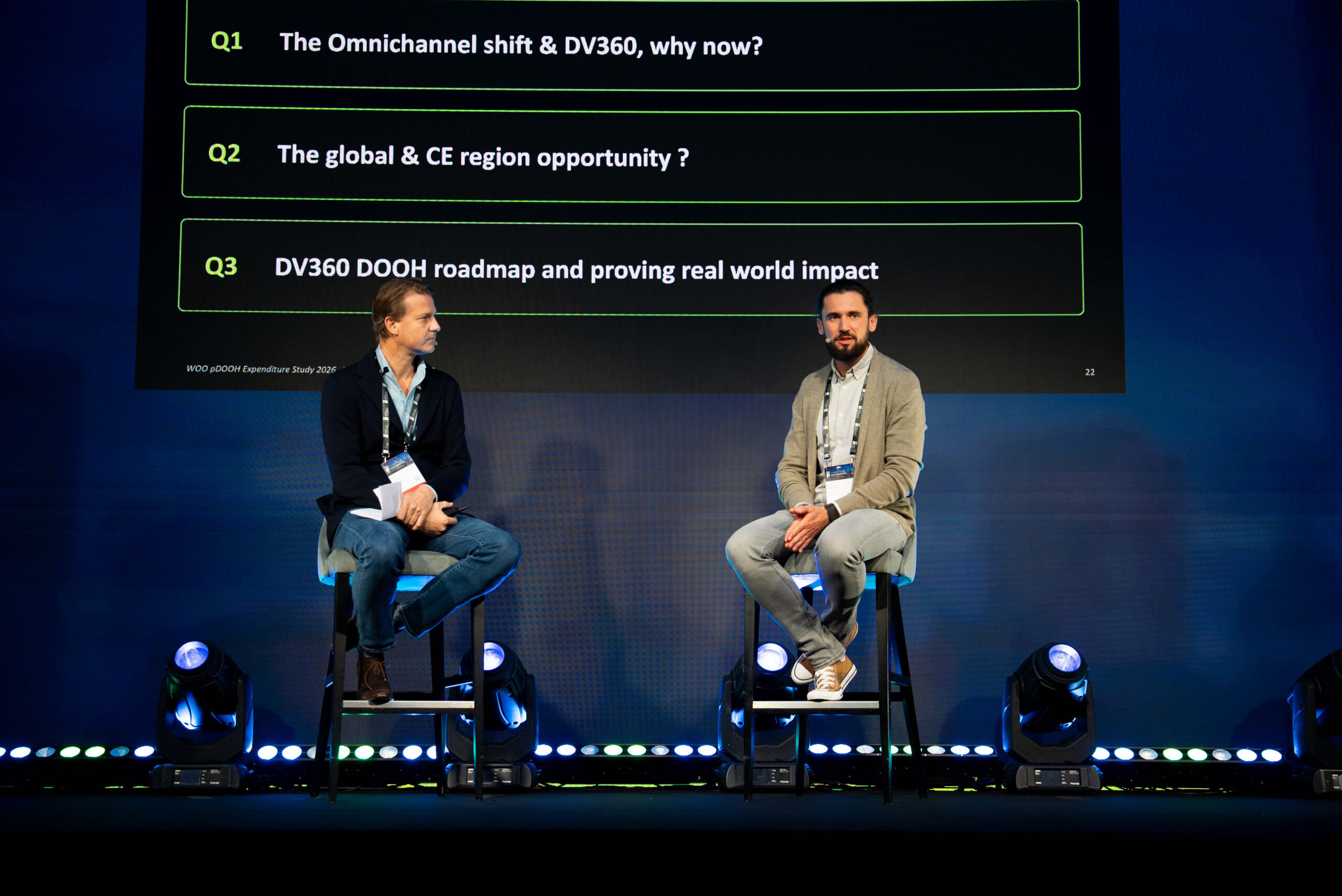
At the 2026 WOO Central European Forum in Warsaw, Poland, Arthur de Groot, Sales Director, EMEA at Broadsign, sat down with Kamil Glenszczyk, DV360 Programmatic Lead, Central Europe at Google, to unpack this evolution. Together, they explored how major platform investments, regional market momentum, and smarter automation are removing historical friction and unlocking new digital budgets for OOH media.
Here are the three biggest takeaways from their conversation.
Unified buying is breaking down the wall between out-of-home and digital
Major digital buying platforms like Google Display & Video 360 (DV360) are expanding their programmatic DOOH capabilities, making it easier for advertisers to incorporate the channel into omnichannel campaigns alongside online video, connected TV (CTV), and audio. As DOOH becomes more accessible through established digital buying workflows, trading desks can plan and activate campaigns with greater speed, efficiency, and flexibility.
“There is no more wall between out-of-home and digital,” said Glenszczyk. “This year marks a turning point for how trading desks activate out-of-home.” This evolution is allowing advertisers to move beyond treating OOH as a separate media buy, connecting their strategies across channels and extending campaign storytelling from personal devices to digital screens in real-world environments.
For de Groot, the growing commitment from major buying platforms represents a significant step forward for the industry: “Having one of the world’s leading DSPs build dedicated infrastructure for our channel is a monumental milestone for digital out-of-home.”
Beyond streamlining campaign activation, this shift is creating new opportunities for media owners to tap into digital advertising budgets that have traditionally been concentrated in other channels, bringing OOH further into the broader omnichannel media mix.
Screen fatigue and brand trust are fueling a growth runway
With consumers spending much of their day on smartphones and laptops, digital overload is pushing brands to look for high-impact extensions in the physical world. Public digital screens offer a refreshing solution: unskippable brand storytelling in everyday spaces. “There’s a kind of screen fatigue in society,” Glenszczyk explained. “Digital out-of-home offers a very non-intrusive way to show the next part of the story.” Because out-of-home reaches crowds rather than tracking individuals, it also gives brands massive scale in a credible, brand-safe environment without relying on cookies or personal data.
This combination of public trust, privacy, and impact is creating significant room for expansion both globally and across Central and Eastern Europe. Worldwide, just 7% of global DOOH advertising spend was transacted programmatically in 2025, compared with an estimated 85% of connected TV advertising purchases in the U.S. As de Groot pointed out during the session, combining that gap with the opportunity to convert budgets from other digital channels creates a staggering runway for growth.
That momentum is already visible across Eastern Europe, where DOOH spending reached $438 million in 2025, accounting for nearly 34% of the region’s out-of-home spend. Programmatic DOOH in the region is forecast to surge 50% year-over-year, growing from $30 million in 2025 to $44 million in 2026. It’s a clear sign of how quickly brands are turning trust in the medium into real programmatic investment.
Smarter creative and stronger measurement are powering real-world impact
One of the clearest signs of programmatic DOOH’s maturity is how much simpler campaigns have become to build and scale thanks to recent tech advancements. For example, rather than requiring teams to manually resize assets for different screen formats, buyers can now manage multiple creative dimensions within a single line item, with automated size-matching logic pairing the right video aspect ratio to each targeted screen.
Combined with workflow automation and clearer standardization across inventory, buyers gain sharper visibility into where their ads run, like whether a placement is indoors or outdoors, while making multi-screen campaigns easier to launch.
Once those workflows are streamlined, brands can tap into what truly sets DOOH apart: contextual relevance in the real world. Using live data feeds, advertisers can automatically swap their creative based on local weather shifts, morning versus evening commutes, or real-time moments like a goal scored during a live sports tournament.
Advancements in measurement are also giving advertisers greater confidence in how those campaigns perform. As Glenszczyk emphasized, the industry is actively building solutions to bridge the digital and physical worlds through new venue-level reporting and privacy-safe integrations with first- and third-party measurement partners.
By helping brands move beyond traditional reach and impression metrics to better understand how physical screen exposure contributes to business outcomes, these innovations are making real-world screens more dynamic, measurable, and ready for broader omnichannel investment.
Looking ahead
The next phase of programmatic DOOH is about far more than automating how screens are bought. It’s about making real-world media a natural, measurable part of how modern brands tell stories across every channel. As de Groot summed it up at the close of the session, “The infrastructure is ready, the trust is there, and the budgets are moving.” For both advertisers looking to cut through digital fatigue and media owners ready to capture fresh omnichannel demand, the opportunity in out-of-home has never been clearer.