The economic uncertainty and government-mandated lockdowns brought on by COVID-19 saw a decrease in spending in the out-of-home (OOH) advertising space for 2020. Faced with tighter budgets, advertisers had to reassess the need for large upfront commitments that come with traditional OOH media buys – e.g. frequency-based campaigns that purchase slots in a loop, and often require media buyers to book months in advance and tie them in for long periods of time.
Unsure of when the next lockdown would be, media buyers needed a solution that allowed them to activate and pause campaigns when needed. While this led to many advertisers turning towards programmatic buying during the pandemic, the majority of campaigns in OOH still bought through direct sales. Flexibility in direct sales was needed now more than ever.
As most parts of the world began their recovery and OOH returned to pre-pandemic levels, the demand for flexibility in direct sales remained as it enabled media buyers to quickly respond to new consumer demands and expectations. By providing the same flexibility that digital advertising offers, media owners were able to create new revenue opportunities by opening their network to buyers that traditionally purchased ad space programmatically or online.
How media owners can adopt more flexibility in direct sales
Adopting flexibility in direct sales may sound like a large undertaking, as it requires you to move away from a selling environment that you are familiar with. But this doesn’t need to be an all-or-nothing approach. The easiest way is by offering flexible campaign types in addition to the more traditional ones which are frequency, takeover or fixed share of voice. A campaign type determines how an ad is distributed across a set of screens.
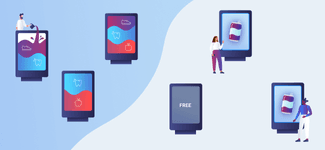
Unlike fixed campaigns that often restrict your customers to a slot in a loop, a specific time period, or a location, flexible campaigns allow them to decide how often their ads should play based on their desired campaign goal. Similar to how digital advertising is bought, flexible campaigns are set based on the desired impression, play, budget or share of voice goal.
By offering similar campaign goals as other ad mediums, you can facilitate the creation of omnichannel campaigns for your customers while also securing new budgets from digital advertisers who are looking to incorporate DOOH in their strategies. As more advertisers adopt and expect to book flexible campaigns in direct sales, having the right tools that can automatically optimize inventory to accommodate both fixed and flexible campaigns will become a key competitive advantage for you.
Flexible campaign types hit your campaign goals, every time


With a more flexible direct sales strategy, media owners will need to change how they market their inventory. Offering screen packages to customers looking to buy more flexibly will be crucial. By grouping screens based on whether it meets the criteria to hit your customers campaign goal enables you to offer them more targeted advertising capabilities in direct sales.
However, this also doesn’t need to be an all-or-nothing approach. Media owners should be able to decide whether they want to allocate all or part of their inventory to flexible campaign types. With Broadsign, they can choose how much flexibility they would like to incorporate into their direct sales strategy with access to a wide range of fixed and flexible campaign types. Below are just a few examples of the type of flexible campaigns we support:
Play goal
A play goal allows you to define how many times the ad should play. Broadsign ensures that the goal is met and distributed across all selected screens in the most optimal way possible for the campaign’s duration.
Impression goal
An impressions goal lets you decide how many people you would like to see your ad. This goal is met and distributed in a similar fashion as a play goal.
Budget goal
Depending on the budget provided to media owners by their customers, Broadsign will calculate the number of impressions they can guarantee and optimally deliver the ad across all desired screens throughout the campaign. This campaign type is particularly useful for customers that want their ad to be seen on as many screens in as many locations as possible, ensuring maximum visibility while respecting the defined budget.
Share of Voice
Customers can essentially buy a percentage of time on the screens. The desired share of voice can be met either by the end of the campaign, on a daily basis, or on a daily basis per screen.
A flexible network is better optimized for revenue
An advantage to booking and managing your customers’ flexible campaigns with Broadsign is that it gives you access to our optimization engine. Purpose-built to help you navigate and balance the need to offer more flexible campaign types, our optimization engine strategically moves booked flexible campaigns to make room for new ones.
This is something that can’t be done with fixed campaigns. Without the ability to adjust fixed campaigns to accommodate new requests, unnecessary roadblocks are created for campaign planners in direct sales. Media owners are also more likely to find gaps in their inventory that are difficult to fill. Both situations are not ideal, as they ultimately result in lost revenue.
Most media owners are already rearranging their existing campaigns to make room for new ones. This is often done manually through spreadsheets, which is time-consuming, prone to mistakes, and an inefficient process that cannot scale with your business. Why opt for a manual process when you can simply click a button and watch our optimization engine provide you with the best way to allocate your inventory to maximize screen fill rates and revenue? To learn more about our optimization engine, you can read more about it here.
The shift towards more flexible campaigns is inevitable. As demand for flexible campaigns continues to grow, media owners that can offer them today will be better positioned to secure new budgets and gain a competitive start to the new norm of flexible buying in direct sales.
Open your network to new revenue opportunities with Broadsign’s flexible campaign tools!
Get your Broadsign demo today.