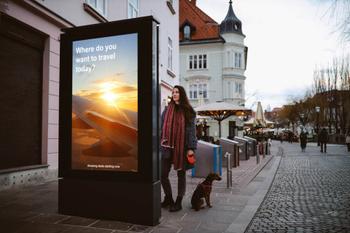
Despite economic challenges, demand for travel isn’t slowing down. Recent research shows that 93% of Americans plan to travel in 2026, with nearly half prioritizing it in their financial planning. Travellers are committed to getting away, but how they plan and book those trips has changed.
Marketing in the travel and tourism industry now means navigating a more fragmented journey. With more than 80% of travellers saying booking online is essential, and nearly half using AI to plan their trips, the path to booking is rarely direct. Today’s journey spans social, search, CTV, mobile apps, and real-world touchpoints, which means brands must deliver experiences that feel connected at every stage.
That’s where out-of-home (OOH) advertising plays an important role, extending digital strategies into the real world to reinforce messaging, prime audiences, and bridge the gap between inspiration and final booking.
Turn awareness into action
For travel and tourism marketers, awareness alone isn’t enough. It needs to drive action, and OOH plays a more direct role in that process than many realize. Research from the Out of Home Advertising Association of America (OAAA) shows that 74% of mobile users took action on their phones after seeing a digital OOH (DOOH) ad, with 44% searching for the brand, 38% visiting its website, and 30% checking social channels.
It also consistently outperforms other media in driving digital response. According to OAAA and Comscore, OOH generates online activation rates five to six times higher than expected, beating channels like TV, radio, banner ads, print, and even online video. For travel brands navigating a fragmented booking journey, that kind of cross-channel impact is exactly why an omnichannel approach matters.
Keep campaigns agile with programmatic DOOH
Programmatic digital out-of-home (pDOOH) has fundamentally shifted how travel and tourism brands can integrate OOH into omnichannel campaigns. Instead of managing placements market by market with long lead times, marketers can activate across multiple cities or countries from a single platform. For campaigns that often span key markets, that level of scale and coordination is critical. Teams can launch quickly, maintain consistent messaging across regions, and still tailor creative to local audiences.
Programmatic buying also introduces additional flexibility from traditional OOH. Budgets, creative, and targeting can be adjusted mid-flight based on performance data or shifts in traveller behaviour. If demand rises in one market, spend can follow. If bookings soften, messaging can pivot. In a category shaped by seasonality, economic shifts, and cultural moments, that agility matters. It also ensures OOH stays aligned with digital channels, moving in sync with the broader media mix rather than operating in isolation.
Dynamic Creative Optimization (DCO) adds another layer of relevance. Creative can adapt in real time based on signals like location, weather, language, or time of day, allowing campaigns to feel timely and context-aware. A winter cold snap in Chicago, for example, can trigger creative promoting a warm beach getaway. Instead of running static messaging everywhere, travel brands can deliver the right inspiration at the right moment.
Connect offline impact to online conversion
One of the biggest advantages of programmatic DOOH is its ability to turn physical exposure into digital action. By leveraging first and third-party data, travel marketers can extend their online audience strategies into OOH, reaching the same consumers across environments with consistent messaging.
In practice, that might mean a bold airport or transit ad prompting travellers to explore a destination online or check availability. Through geofencing and mobile retargeting, those same audiences can later be served tailored ads that reinforce the message and encourage them to book. Using privacy-compliant, anonymized mobile IDs and device ID passback, brands can reconnect with exposed audiences across mobile, CTV, display, social, or audio, creating a coordinated path to conversion.
Just as important, this activity is measurable. For years, OOH was seen as difficult to quantify beyond awareness, a challenge in a results-driven category like travel. Today, advances in location intelligence and attribution modelling allow marketers to connect exposure to real-world behaviour. Travel brands can track visitation uplift, overnight stays, and the broader path to purchase by matching anonymized mobile advertising IDs to campaign exposure. This makes it possible to quantify incremental arrivals and foot traffic tied directly to OOH.
Measurement also extends into digital performance. Web and app lift studies can reveal increases in searches, site visits, and bookings, while sales and brand lift studies provide insight into revenue impact and shifts in awareness or intent.
For tourism boards and travel brands, proving impact isn’t optional. Budgets are often tied to partners, stakeholders, or public funding, which means showing clear ROI matters. When measurement is built in from the start, it becomes much easier to report on performance, optimize along the way, and make smarter decisions about where to invest next.
Real-world example: Visit Arizona drives a 30% increase in arrivals with pDOOH
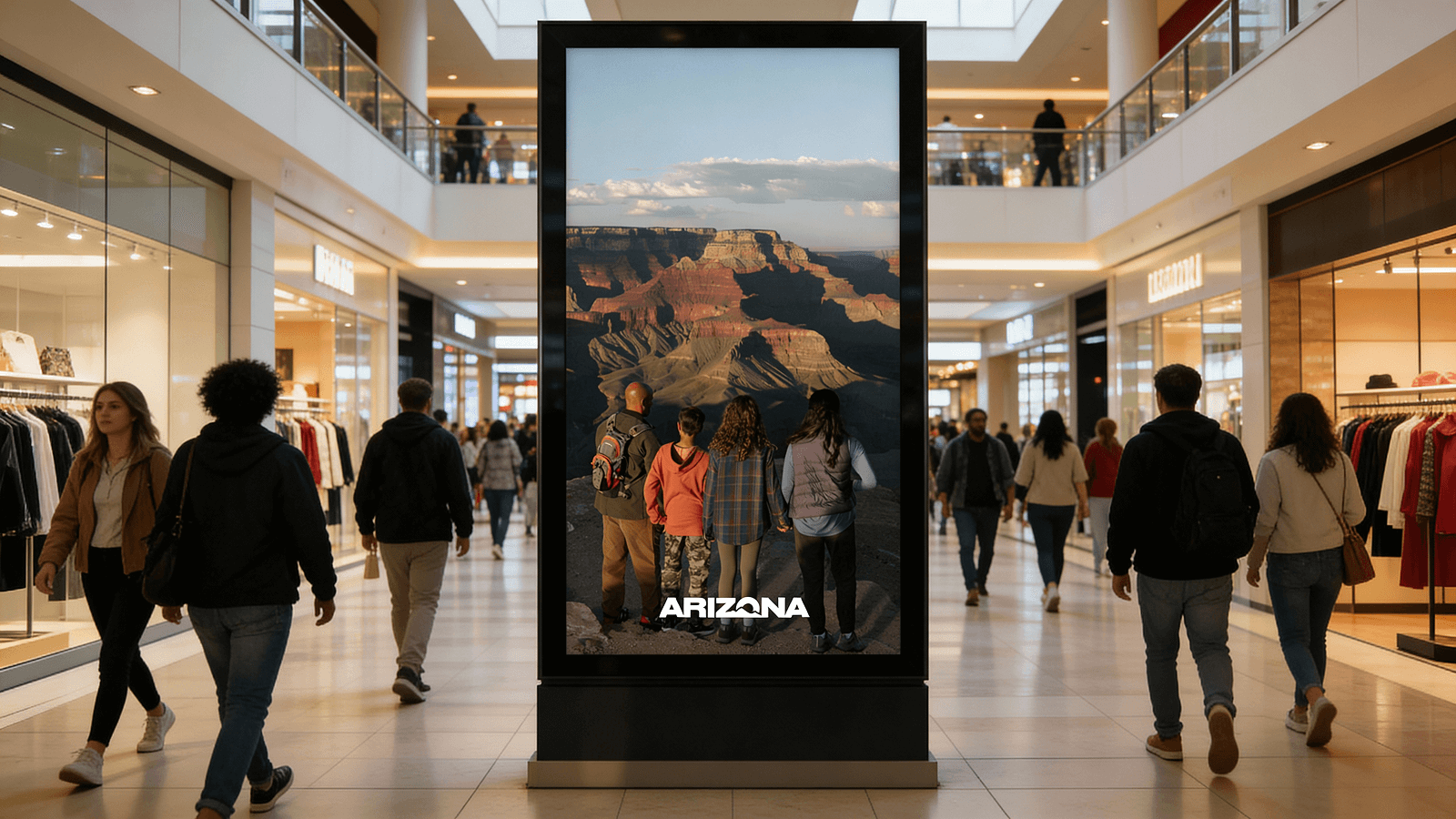
Visit Arizona set out to build top-of-mind awareness while driving measurable increases in arrivals. From the start, the campaign was built as an integrated effort, combining DOOH, mobile retargeting, and arrival lift measurement to connect exposure across channels and tie it back to real-world visitation.
Planned by agency of record Off Madison Ave, the campaign tapped into the OutMoove DSP to run DOOH placements in high-traffic venues across key markets. Programmatic buying made it possible to focus on Visit Arizona’s High Value Personas, keeping the destination visible during travellers’ daily routines and at important moments in their planning journey.
Read the full Visit Arizona case study
What made the campaign truly omnichannel was how each touchpoint worked together. Consumers exposed to DOOH were later re-engaged through mobile retargeting, extending the conversation beyond the physical environment and reinforcing messaging in a more personal, digital context. The mobile ads achieved viewability rates of over 90%, highlighting strong cross-channel alignment and continuity.
Measurement was also integrated across the whole journey. An arrival lift study linked campaign exposure to actual visitation, showing a 30% lift in arrivals, well above the 23% national benchmark for similar campaigns.